
Uncategorized
Rental Annexe Outcomes: What Homeowners Can Expect
Oct
A well-designed rental annexe can change how a property works for years to come. The best rental annexe outcomes are not simply about receiving rent each month. They come from providing a comfortable, permanent home that a tenant can genuinely live in, while the homeowner has clarity on compliance, energy use, maintenance and the practical demands of being a landlord.
For many homeowners, a 45 m² home offers enough space to create independent accommodation without taking on the scale of a conventional extension or second property. But the outcome depends on decisions made before construction begins: the intended use, the site, the specification and whether the arrangement meets the relevant planning, Building Regulations and tax conditions.
What good rental annexe outcomes look like
A successful rental arrangement should feel dependable for both parties. For a tenant, that means a private, warm and properly equipped home with reliable heating, ventilation, kitchen facilities and a suitable bathroom. For the homeowner, it means an asset that is built for year-round occupation, has predictable running costs and can be maintained without constant remedial work.
Comfort is central to rental appeal. A home that is cold in winter, overheats in summer or suffers from condensation is difficult to let and can create avoidable disputes. High-performance insulation, carefully fitted windows and doors, efficient heating and controlled ventilation all affect the everyday experience of living in a smaller home.
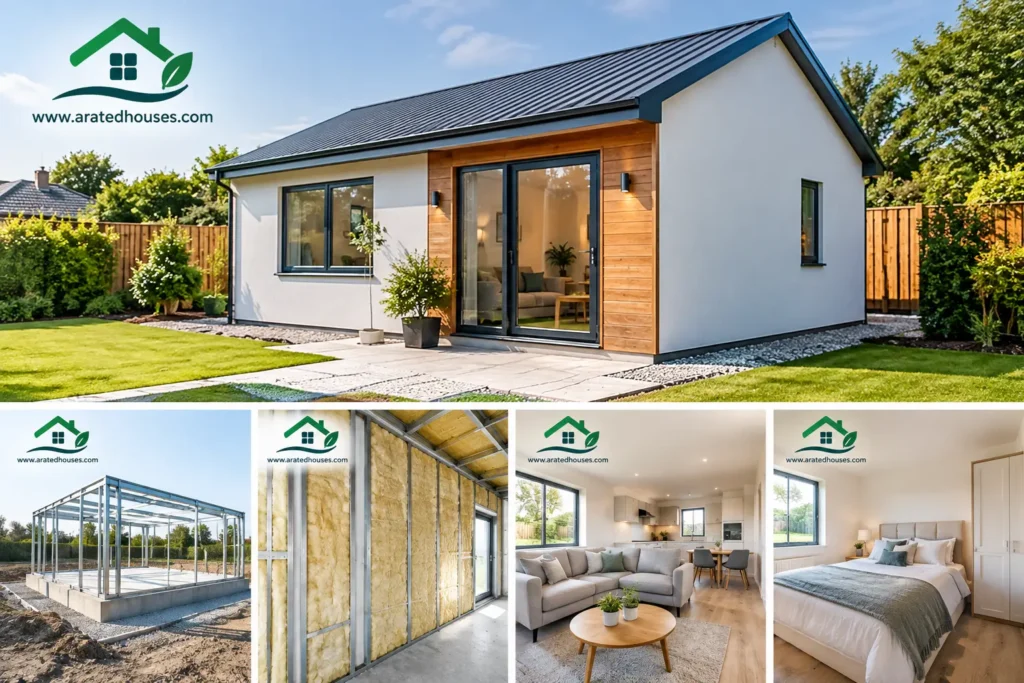
A permanent steel-frame house can be designed around these realities from the outset. Rather than treating insulation and ventilation as add-ons, they form part of a complete building fabric intended to support comfortable occupation throughout the year. The result may be a more appealing home for a tenant and a more manageable proposition for the owner.
Tenant demand is about liveability, not floor area alone
Forty-five square metres can work exceptionally well when the layout is considered carefully. Storage, natural light, circulation space and the relationship between the kitchen, living area and bedroom all matter. A compact home should feel purposeful rather than cramped.
Tenants will also look at the details that shape ordinary routines: space for laundry, enough kitchen storage, good lighting, privacy from the main house and reliable broadband-ready services. These are not luxury extras. They help determine whether a tenant sees the home as a place to settle, rather than a short-term compromise.
Rental income needs a realistic framework
Rental income can help a homeowner meet the cost of a new home, support household finances or provide a longer-term return. However, it should be assessed cautiously. Local demand, the standard of accommodation, tenancy length, utilities, furnishing, insurance and ongoing maintenance can all affect the net result.
It is sensible to budget for more than the initial build. Allow for furnishing, connection costs, professional advice where needed, landlord insurance, periodic repairs and periods when the accommodation may not be occupied. A lower-energy home may reduce the burden of heating costs, but it does not remove every running cost or responsibility.
Ireland’s Rent-a-Room Relief may be relevant where all scheme conditions are met. The relief has allowed qualifying rental income of up to €14,000 a year, but eligibility depends on the homeowner’s circumstances, the property and the letting arrangement. It should not be assumed that every separate home or rental arrangement qualifies. Check the current Revenue guidance and obtain appropriate professional advice before relying on a tax outcome.
Set expectations with the right tenancy arrangement
Clear written terms protect both homeowner and tenant. They should address rent, deposits, utilities, access, notice arrangements, parking, waste collection and responsibility for minor repairs. Privacy needs particular thought where the rental home sits within the grounds of an existing house.
The most positive outcomes usually come from clarity at the beginning. A tenant should understand which areas are private, how meters or utility charges are handled, and who to contact if something needs attention. Homeowners should also consider how they will manage the arrangement if their own family circumstances change.
Planning and compliance shape the outcome
A planning exemption can make a project more straightforward where all applicable conditions are satisfied, but it is not automatic. The site, the existing house, the size and position of the proposed home, services, use and local requirements all need careful consideration.
A homeowner should establish the intended use early. Accommodation for a family member, additional space connected to the main home and qualifying rental use can have different practical and regulatory implications. Changing the intended use after construction can introduce complications that would have been easier to address at the design stage.
The permanent home itself should also be designed and constructed to meet applicable Irish Building Regulations. This matters because a rental home is not just an additional room. It needs to perform as a safe, durable and comfortable place to live, with appropriate attention to structure, insulation, ventilation, fire safety, drainage and building services.
A clear specification is valuable here. Knowing what is included in the build, from steel-frame construction and insulation to windows, internal finishes, kitchen, bathroom and connection-ready services, helps prevent uncertainty later. A turnkey approach can also make it easier to coordinate the many decisions involved in creating a habitable home.
Energy performance protects comfort and costs
Energy performance is one of the most meaningful long-term rental annexe outcomes. Tenants increasingly expect a home that is comfortable to heat and does not produce unwelcome utility bills. Homeowners benefit too, because an efficient property is easier to present, more enjoyable to occupy and less likely to generate complaints about cold or damp.
An A-rated or BER-focused design is influenced by the whole system, not one product. Triple insulation, airtight construction details, high-performance glazing, efficient heating, ventilation and renewable-energy options can work together to reduce heat loss and support a stable indoor temperature. The final BER rating and energy use will depend on the completed specification, site conditions and how the home is operated.
Solar panels, battery storage and renewable heating may suit some projects, particularly where the homeowner wants to reduce reliance on purchased energy over time. The right choice depends on budget, roof orientation, anticipated electricity use and the overall heating strategy. It is worth assessing these options as part of the original design, rather than trying to add them after the build is complete.
Do not overlook ventilation
A warm, well-insulated home needs effective ventilation. Moisture from cooking, showering and everyday living must have a controlled route out of the building. Good ventilation supports indoor air quality, helps manage condensation and protects finishes over the longer term.
This is especially relevant in compact accommodation, where daily activities take place close together. A properly designed ventilation strategy is not a technical detail for a specification sheet. It is part of what keeps the home fresh and comfortable for the person living there.
Think beyond the first tenancy
The value of a permanent 45 m² home is its flexibility. Rental use may be appropriate now, but future needs can change. The same space might later support an adult child, an older parent or a family member who needs more independence while remaining close by.
That flexibility is strongest when the home is built to a permanent residential standard rather than around a narrow, short-term purpose. Durable materials, a practical layout and an energy-conscious specification can help the accommodation remain useful as household priorities evolve.
Before starting, write down the outcome you want in five years, not only the rent you hope to receive in year one. If the home delivers privacy, comfort, compliance and low day-to-day demands, it can continue to serve your family and your property long after the first tenancy ends.
